Service
Turnkey cosmetics store development
One shade sells out while ten next to it sit still, because the photo does not show them. Questions about ingredients and shelf life arrive as messages instead of being read on the page. And past buyers do not come back: a repeat order takes longer than the first one.
What's included
Ingredients, shades, curated sets: what goes into your store
Why this is a separate task
- A shopper in a cosmetics store picks shade No. 12 in a 50 ml size, reads the INCI ingredient list, filters for dry skin, and checks the expiry date and reviews. Break any step in that journey and the questions land in your DMs while the cart sits abandoned. That's why everything below is the baseline of a cosmetics store, not an "extra billed separately."
Catalog and product variants
- Shade + volume variants — one product page, several SKUs. The shopper picks "Powder, shade Nude 03, 8 g" and sees the color swatch, the stock on hand, and the price for that exact variant. When a variant runs out it's marked "out of stock" but doesn't disappear from the catalog.
- Shade swatches — interactive color selection on the product page. Click a swatch and the photo switches to that shade; the price and SKU update. No page reload.
- Ingredients and certificates — separate blocks on the product page: the full INCI ingredient list, a downloadable quality certificate, and a safety certificate. The admin edits them without a developer.
- Shelf life — a "period after opening" field and a "batch manufacturing date" field on the product page. We show them for niches where it matters (organic, natural cosmetics).
- Catalog filters — by skin type, purpose (hydration / sun protection / tinting), brand, volume, price range, and rating. The page doesn't reload.
- Curated sets by skin type — dedicated landing collections (dry, oily, combination, sensitive skin) cross-linked from product pages. They bring SEO traffic and make the choice easier.
Payment and delivery
- LiqPay and Fondy — Visa/Mastercard, Apple Pay, Google Pay, and installment payments from Monobank and PrivatBank. You switch the active gateway from the admin panel, no code changes needed.
- Nova Poshta API — delivery cost is calculated at checkout (branch or courier), the shopper can see parcel tracking in their account, and SMS status updates go out automatically.
- Returns and exchanges — a form in the customer account: choose the product, give a reason, upload a photo (required for cosmetics with opened packaging). A legally correct flow for personal-care goods.
Loyalty program and repeat purchases
- Bonus system — points earned per purchase, referral points, and loyalty tiers (Bronze / Silver / Gold). The shopper sees their bonus balance in their account and at checkout.
- Repeat-purchase reminders — an automatic trigger in Telegram or email X days after the last order. The "X" is configured per category (foundation — 60 days, shampoo — 45).
- Bundles and gift sets — a separate product type: several products in one SKU, a fixed discount, custom wrapping. Useful for seasonal campaigns and B2C gifts.
Inventory and integrations
- Stock sync with 1C/CRM — a two-way exchange: an order on the site deducts stock in 1C, and a received batch appears in the catalog on its own. You don't keep two databases by hand.
- Google Merchant Center feed and Meta Catalog — products are exported automatically: XML for Merchant Center requirements, JSON for the Facebook/Instagram Catalog. We set up the first sync.
- Excel import — when there's no inventory system yet: we give you a spreadsheet template, upload the first batches together, and then your content manager runs the catalog alone.
Case studies
Beauty stores that get orders every day
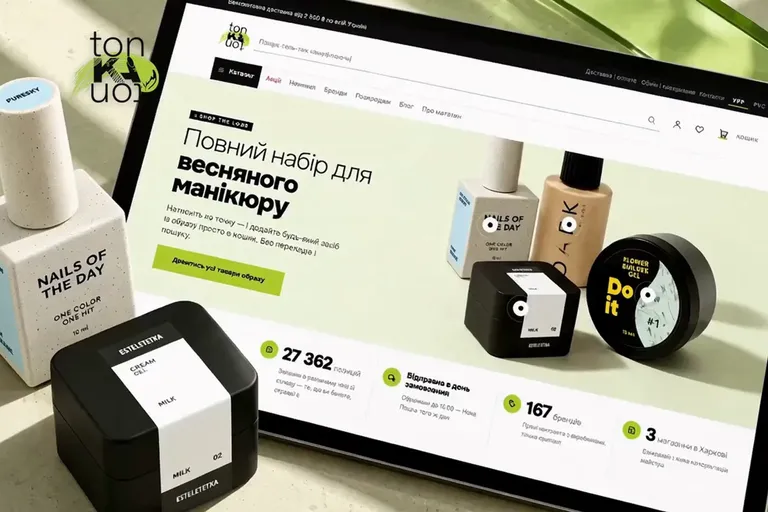

How we work
Five stages to launch a cosmetics store
Brief and specification
Half an hour on Zoom. We ask: how many SKUs, which brands and lines, whether you need a loyalty program, what your inventory setup is (1C/CRM/warehouse), and how delivery works. You get: a spec — a page map, a list of features and integrations, a budget range, and timelines.
Design
We design the catalog, the product page with swatches, variants and an ingredients block, the cart, checkout, and the customer account with a bonus balance. Three rounds of edits, all within budget. You get: desktop and mobile mockups approved by you, and a fixed price for the full scope.
Development and catalog population
We build and populate in parallel: your content manager uploads products using our template, or we take on the first batch ourselves. Weekly deploys to staging. You get: a working store on staging with real products, swatches, and integrations.
Integrations and testing
We connect LiqPay/Fondy, Nova Poshta, 1C or CRM, and the bonus module. We verify with live transactions: we pay with a real card, watch the bonuses accrue, and run tracking and returns. You get: a signed test report — payment, bonuses, and returns all verified.
Launch and handover
Migration from the old site, if there is one, redirects, GA4, Google Merchant Center. For the first month after release we're right there — support is already in the price. You get: a live cosmetics store, a guide for the content manager, and 30 days of support.
Numbers
years in business
SKUs in the catalog
weeks — average time to launch a cosmetics store
FAQ
Answers to the essentials about launching a cosmetics store
Let's talk
Tell us about your range — we'll give a range and a timeline
- 30 minutesOne-on-one online
- Flexible formatVideo or phone call
- Solution-focusedPractical answers

More detail
A turnkey cosmetics online store: what sales are really built on
A cosmetics store differs from a clothing or electronics store in the nature of its variants. One product — 30 shades and three volumes, meaning 90 SKUs with their own stock, photos, and prices. Now add a few hundred catalog positions, and it becomes clear why building a cosmetics online store isn't the same as "a regular site with a cart."
The core mechanic is shade swatches on the product page. The shopper opens one page but buys something specific: shade No. 15 "Peach," volume 30 ml. The site shows the photo for that exact shade, checks the stock for the "15 + 30 ml" pair, and updates the price. Without it there are only two outcomes: a blind order that comes back as a return — or a closed tab. Working swatches and variants are the condition without which a cosmetics store won't convert. You can see how this mechanic looks in a live store on our portfolio page. Portfolio →
Trust in the cosmetics niche is built through ingredients and certificates. A shopper with sensitive skin reads the INCI ingredient list before ordering; an organics shopper looks for the certificate. If that data isn't on the product page, they go where it is. We build in an "Ingredients" block with search by ingredient, a "Certificates" block with PDFs to download straight from the page, and a "period after opening" field. The admin edits all of it, without going to a developer. What's included in the baseline scope of any store is on the e-commerce development page. E-commerce development →
Cosmetics is a niche with natural repeat demand: shampoo runs out in a month, cream in two. If a loyalty program ever pays for itself in full, it's here. We set up trigger reminders — X days after an order, Telegram or email with a direct link to the product — and a tiered bonus system: the shopper accumulates points, sees them in their account, and spends them on the next order. It's a ready-made module, not custom development on a separate budget.
Advertising options here come down to the quality of the product feed. Google Shopping requires not just a name and price but also a GTIN, brand, and additional_image_link — a separate photo for each shade. The Facebook/Instagram Catalog pulls the same data for Dynamic Ads. A feed assembled incorrectly means the ads either fail moderation or show the wrong product variant. We generate XML for Google Merchant Center and JSON for Meta with every field the cosmetics niche requires, and we set up the first sync before launch day — so you can run cosmetics-store ads in the first week, not a month of tweaks later.
Curated sets by skin type are an SEO tool that brings organic traffic. The query "cream for dry skin" has its own search volume in Google, and that traffic goes to the store that has a dedicated collection page for it. We build the collection architecture from the start: each product page is tied to skin types, each collection is a separate URL with its own metadata, and the admin adds new products in two clicks. Prefer to talk it through? Tell us the task and in 30 minutes you'll know what it takes for your cosmetics online store to sell and bring customers back. Get an estimate →