Development
GuideB2B website design vs B2C — the difference you can see on the page
Where B2B and B2C websites actually part ways: a visible price or a quote request, a cart or a dealer portal, card payment or an invoice with VAT.
 Bohdan Kononenko13 min read
"B2B is business to business, B2C is business to consumer." Every top search result will tell you that, and then goes quiet. The questions about B2B website design that clients actually bring us start where those articles stop. Do we put the price on the page or a "request a quote" button? Do we build a cart or a customer portal? Do we need a sales receipt if the money arrives as a bank transfer from a company?
The difference between the two models isn't terminology. It's a set of concrete interface decisions, and each one either brings in a lead or kills it.
Who sells to whom
B2C (business to consumer) means you sell to an individual for personal use. Sneakers, an English course, food delivery, a dentist. One person makes the decision, often in a few minutes, and pays by card on the spot.
B2B (business to business) means you sell to a company that will use what it buys in its own operations. Wholesale, equipment, raw materials, software, contract services, logistics. The buyer is a legal entity, the money comes from a business bank account, and the decision isn't made by the person who first landed on your site.
Nielsen Norman Group puts it plainly. B2B purchases are rarely impulsive. They come out of a long and complex decision process, because the products are expensive and meant to last. And by NN/g's own account, several people from different levels of the hierarchy and different functional roles make that decision. How many people, exactly? We'll be honest: we don't know. The numbers that circulate in blogs trace back to paywalled reports we couldn't read, and we're not going to repeat someone else's retelling.
Those two paragraphs shape everything else that happens on your site.
Price on the page or "request a price"
This is the most expensive decision in the whole project, and it's almost always made wrong.
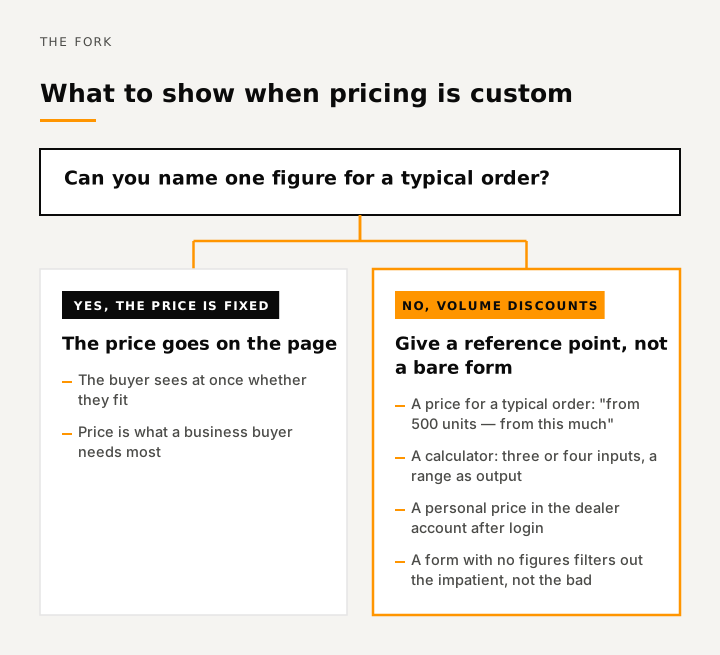
In B2C the question doesn't come up. There's a price, period. In B2B you hear the familiar line: "Our pricing is individual, there won't be prices on the site." The argument has a basis. NN/g agrees that B2B products are often heavily customized for a specific client and come with substantial volume discounts, so you really can't put one simple number on them.
The problem is that buyers don't accept it. When NN/g asked business users to rank 28 types of information on a B2B site by importance, price scored 29% higher than product availability, which came second. In 2013 NN/g wrote it straight out: in their tests, participants left for competitors when the price was missing. Back in 2002 they had already named the lack of clear pricing on B2B sites the number one web design mistake of the year.
Here's what we do in practice instead of choosing all or nothing.
- A price for a typical scenario. This is exactly what NN/g recommends: show the cost of a set of typical orders. "Batches from 500 units, from X per unit." The client can tell whether they're a fit and doesn't waste your time.
- A calculator with a range. Three or four inputs, a price range as the output. The lead arrives with its numbers already filled in, and the sales rep doesn't start from zero.
- A price after login. A personal price inside the dealer portal is the proper answer to "everyone gets their own discount."
- An empty "request a price" form with no reference point at all is the worst option. It doesn't filter out bad clients, it filters out impatient ones. And the best clients are impatient.
We hit this fork on every website development project, and in ten years we haven't seen a single case where hiding prices completely brought more qualified leads than a price range did.
Cart or customer portal
In B2C the cart is the center of the universe, and you have to treat it that way. Baymard Institute pulls together 50 different studies and arrives at an average documented cart abandonment rate of 70.22% (data updated in September 2025). Seven out of ten filled carts never become an order.
The reasons Baymard lists read almost like a spec. 40% abandon over extra costs that showed up too high at the end. 18% because the site required an account. 17% because checkout was too long or too complicated. 12% because they couldn't see the order total up front. Baymard estimates that the average large store could raise its conversion rate by 35% just by fixing checkout design, a benchmark built on the 344 largest sites in the US and the EU. We covered how this plays out in practice in a separate piece on building an online store from scratch.
In B2B that whole setup falls apart. You don't want guest checkout here. The opposite, actually: only the people you've let in get to buy. That's why a wholesale store almost always ends not with a cart but with a portal.
What shows up in that portal that B2C doesn't have at all:
- Personal price lists. The same item costs different amounts for different accounts, and each one sees its own price.
- Order multiples and minimum quantities. Not "1 pc." but "case of 24, minimum 5 cases."
- Quick order by list. A purchasing manager doesn't browse the catalog, they paste SKUs from a spreadsheet. A CSV upload form saves them an hour, and that's what they'll remember you for.
- One-click reorder. Recurring purchases are 80% the same.
- Credit limit, payment terms, contract balance. This isn't a store anymore, it's a window into your accounting system.
- Multiple users per account. A warehouse clerk builds the order, a manager approves it.
That last item is the same "collective buyer," only in the interface. Baymard, by the way, keeps a separate body of B2B research: 27 leading US and European sites scored against 270+ guidelines written specifically for B2B. These are two different disciplines, not one with an adjustment.
If you're stuck at the "do we need wholesale or retail" fork, it gets decided before the design stage. We lay out both branches on our e-commerce development page.
Who makes the decision and what that does to your content
In B2C you write for one person who already wants the thing. In B2B several different people visit the site one after another with different questions, and any one of them can stop the deal.
The engineer looks for specs, certifications, drawings, compatibility. NN/g puts particular weight on compatibility: a B2B client has to be sure the new thing will fit into the company's existing systems and workflows. The finance person looks for payment terms, deferred payment, total cost of ownership. The lawyer looks for the contract and company details. The executive looks for reputation, years in business, similar clients.
Hence the specific blocks a B2C site simply doesn't have: a PDF with technical specifications, a standard contract and a sample order specification, a page with company details, case studies by industry instead of "our work." And hence the main reason B2B companies more often end up with a corporate website than with a store.
Complexity has a price. In the same NN/g study (179 B2B sites, 79 participants, including 55 business users in one-on-one sessions), the task success rate on B2B sites was 58% versus 66% on consumer sites. The study is old, from 2006, and we mention the date on purpose. But the gap didn't come from old technology. It came from B2B sites trying to serve everyone at once. NN/g warns about this directly: a site has to support client companies of every size, from a small family shop to a multinational corporation, without alienating anyone. That's a job for navigation and UX design, not copywriting.
One more thing. A long sales cycle doesn't live on the website. The site hands off the lead, and from there it's handled in a CRM system, by email and on calls. Trying to model every stage of the negotiation inside the site is a classic mistake on first B2B projects.
Payment: card at checkout or an invoice with VAT

In B2C you take the money by card on the site. In B2B, most of the time, you issue an invoice, and the buyer pays it by bank transfer from the company account, often with VAT and often on net payment terms.
For the website these are two different worlds. In the first you need a payment gateway, a payment confirmation page, refund handling. In the second you need an invoice generator, form fields for the company's legal name, registration number, VAT number, billing address and a purchase order number, document downloads, and an "invoiced / paid" status.
Then there's the tax side. A card payment from a consumer is a retail sale, and in most countries it comes with its own reporting duties: a receipt, sales tax or VAT charged at the right rate, sometimes a registered point-of-sale system. An invoice to a company carries a different set of requirements: the buyer's legal details and tax ID on the document, the VAT breakdown, a numbering sequence your accountant can reconcile. Our home market is a good illustration. Ukrainian law treats a card payment on a site as a cash-register transaction that has to go through a registered software register, while wholesale warehouses and payments made only through bank systems are exempt.
So if your site takes cards from consumers, the tax-compliant receipt belongs in the project from day one, not in the "we'll bolt it on later" pile.
This is also why classic B2B lives a calmer life. When money only moves between business bank accounts against an invoice, most of the retail machinery simply isn't there.
One caveat, without which this would be bad advice. The rules differ from country to country and they change, including how VAT is handled when you invoice a business in another country. Before launch, your accountant should always check the payment setup against the rules that apply to you. We build the mechanics. We don't give tax advice.
Forms and registration
In B2C every extra field costs money. In Baymard's summary, 18% of abandoned carts come down to a forced account creation. That's why retail lets guests buy without registering, and a landing page form gets by with two fields. We showed how this comes together into a full page in our breakdown of landing page structure.
In B2B the logic flips. Registration isn't a barrier, it's a filter, and even a selling point. The account registration form asks for the company name, its registration or VAT number, the contact person's job title, expected volumes, region. Then an actual person reviews the application, because access to personal pricing isn't handed out to anyone who asks. A single "VAT number" field here saves the sales team more time than three rounds of emails.
The difference in one sentence: in B2C the form removes friction, in B2B it creates friction on purpose, in the right place.
Shipping and how it shows up on the page
Retail means parcel carriers, national post, couriers, in-store pickup, choosing a pickup point right in checkout from a list that loads as you type, and pay-on-delivery in markets where that's common. All of it is visible on the order page, and every extra step there costs conversions.
Wholesale means pallets, weight-based rates, your own trucks or a freight carrier, an agreed shipping schedule, and shipping documents. On the site that isn't a pickup-point widget, it's a "preferred ship date" field and delivery terms in the contract. Showing live shipping costs is mostly impossible here, and it's more honest to write "we'll quote shipping once the volume is agreed" than to fake a calculator.
The mixed model you'll run into most often
Pure cases are rare. A manufacturer sells to distributors and also runs a retail store for its own brand. A service sells subscriptions to individuals and corporate licenses to companies.
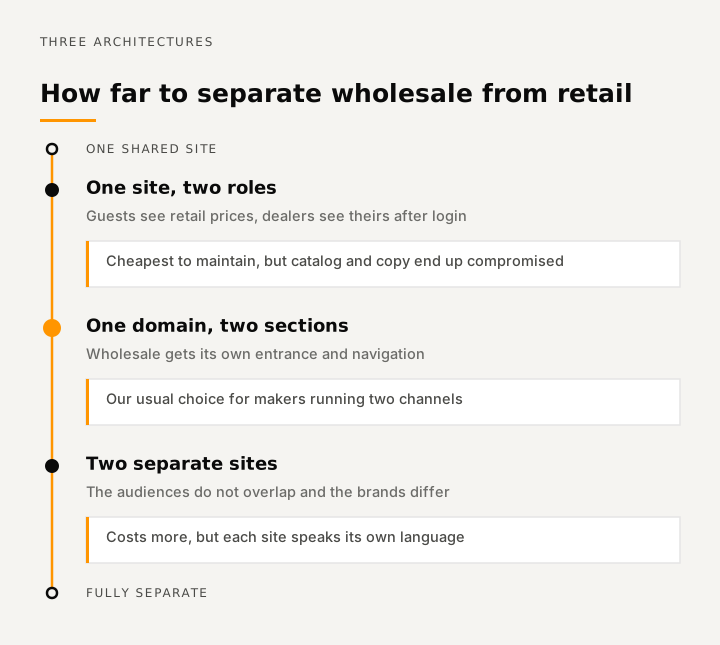
There are three workable setups here, and choosing between them is the main architecture conversation at the start of a project.
- One site, two roles. Guests see retail prices, a logged-in dealer sees their own. Cheaper to maintain, but the catalog and the content end up as a compromise.
- One domain, two sections. A separate wholesale section with its own login and its own navigation. Our most common choice for manufacturers.
- Two separate sites. When the audiences don't overlap at all and the brands are different. More expensive, but each site speaks its own language.
A word on how big the "storefront" itself is. According to Eurostat, EU enterprises got 19.49% of their total turnover from e-sales in 2024. Within that figure, sales through websites and apps made up 8.39%, and structured EDI messages exchanged between companies made up 11.07%. In other words, the automated channel between businesses brings in more money than the storefront does. Web sales to other enterprises and public bodies accounted for 4.34% of turnover, sales to private consumers for 4.04%.
These are EU numbers, and they describe EU companies only. We're not going to pass them off as a picture of every market. But the direction of thought is useful: in B2B the website often doesn't sell on its own, it's the entry point to an integration with the client's accounting system.
One more reference point from the same source: among EU enterprises that sell online, 85.65% do it through their own website or app and 45% through a marketplace. The company's own storefront hasn't lost out to the platforms.
How to choose without guessing
Four questions we ask at the first meeting about any B2B website design. The answers define the backbone of the site more precisely than any typology.
- Who pays, an individual or a company? That immediately settles the receipt, the invoice, and the form fields.
- How many people have to say "yes" before payment? One: keep the path short. Several: create materials the client can show to their management.
- Is the price the same for everyone? Yes: put it on the page. No: build a portal with personal pricing.
- Is the order one-off or recurring? One-off: everything goes into conversion. Recurring: everything goes into reordering and fast SKU entry.
We go through these four questions at the start of every website development project, and this is where it's decided how much the site will cost and how long it will take, not at the stage of picking colors. Current packages and timelines are on our pricing page.
FAQ
What are B2B and B2C, and what's the difference?
B2B is selling to a company that will use the purchase in its operations, B2C is selling to a person for personal use. For a website the main difference comes down to three things: whether everyone can see the price, whether there's a cart or a portal with personal pricing, and whether a card payment triggers a sales receipt and retail tax reporting.
What are some examples of the B2B model?
A wholesale supplier of food for restaurants, a maker of factory equipment, a print shop that works with agencies, a software developer selling corporate licenses, a trucking company on contract. In all these cases the site looks similar: a catalog with access behind a login, an invoice instead of a card, documents for the purchasing manager.
Who are B2B customers?
Companies and self-employed business owners who buy for work, not for themselves. The practical consequence for the site is that the person filling in the form often isn't the one making the decision, so you need materials that "survive" the form and reach the executive as a PDF, a proposal or a specification.
What is B2C selling?
Selling to the end consumer, usually with a quick decision and payment on the spot. On the site that means a visible price, checkout without registration, a minimum of checkout steps, and the full order total including shipping before the person clicks "pay." In Baymard's summary, hidden extra costs are the number one reason carts get abandoned.
How does B2B work?
The buying company studies the offer, compares suppliers, gets the budget approved internally, and only then signs a contract. In that chain the website is responsible for the first step: giving enough information to make the shortlist, and collecting a lead with data the sales rep can price right away. The CRM handles the rest.
If you're reading this because you can't decide whether to put prices on the site, or whether to build a cart or a portal, write to us. We'll look at your sales model and tell you what kind of site you need, before any proposal.
Was this article helpful?
Related articles
 Development
React vs Vue — What Frontends Are Built On in 2026
Guide16 min read
A comparison for whoever pays for the frontend: the hiring pool, stack risk, what maintenance costs, and the honest case where no framework is needed at all.
 Development
Outsourcing Website Development — When to Hand Your Site to a Studio
Guide14 min read
When outsourcing website development makes sense, when to keep a developer on staff, and the contract clauses on IP, acceptance, and exit that decide the project before any code is written.
 Development
When to Choose Jamstack for Website Development
Guide12 min read
Find out whether Jamstack fits your website: separate content, APIs, and integrations, and see where this approach to choosing a stack runs out.