Development
GuideOutsourcing Website Development — When to Hand Your Site to a Studio
When outsourcing website development makes sense, when to keep a developer on staff, and the contract clauses on IP, acceptance, and exit that decide the project before any code is written.
 Bohdan Kononenko14 min read
If you searched for "outsourcing" hoping to read about bookkeeping, call centers, or moving staff off your payroll, this isn't that article. It's about one specific thing: outsourcing website development. When it makes sense to give your website or web system to an outside team, when you're better off keeping someone on staff, and what happens to your code, your access, and your money if things go wrong.
We're writing this from the contractor's side. Apricode is exactly that kind of outsourcer: companies hand us development, maintenance, and marketing. So we know the sales pitch, and we also know the part studio websites usually leave out. Why projects fall apart, which side is more often to blame, statistically, and which three paragraphs of the contract decide the project's fate before the first line of code.
Outsourcing website development is not about paying less
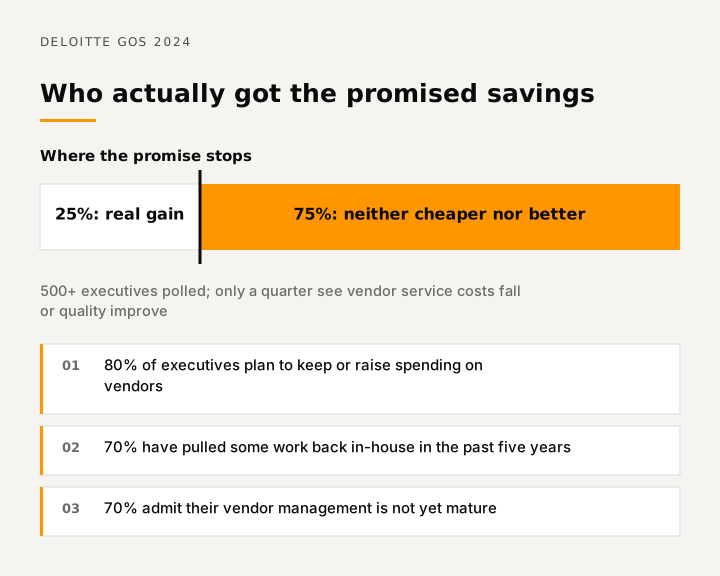
For its Global Outsourcing Survey 2024, Deloitte polled more than 500 executives. Yes, 80% of them plan to maintain or increase spending on outside providers. But only 25% see a real drop in vendor service costs or better quality. And 70% have selectively brought work back in-house over the past five years, work that a vendor used to handle.
Read those three numbers together. The outsourcing market keeps growing, yet the promised savings show up in a quarter of cases, and two companies out of three have already taken something back. Outsourcing development is not a way to pay less. It's a way to buy speed and skills you don't have and couldn't justify as a full-time salary.
The same survey has a number that explains why. 70% of executives admit their vendor management isn't mature yet. In other words, the problem sits with the client more often than with the vendor: nobody is there to set the task, accept the work, and read the contract.
Prices, by the way, are going down worldwide. According to an Accelerance survey of 60 development partners, hourly rates in Europe run $31–39 for juniors and $64–76 for seniors, and they fell 4.4% in a year. In Asia the drop was almost 8%, in Latin America 7.1%. A cheap hour is no longer a competitive edge anywhere. What matters now is how many hours the team will spend on your task and how many of those will have to be redone.
When to outsource development and when to keep it in-house
We walk every client through the framework below at the first meeting, before any estimate.
Keep it in-house if the website or system is your product, not a storefront. If changes ship every week and depend on a hallway conversation rather than a ticket. If the code holds your own pricing or production logic. A peer-reviewed study in the International Journal of Computer Applications says it plainly. When a project goes outside, the organization loses control, because management passes into someone else's hands, and it can no longer run processes the way it or its customers want. The second warning from the same paper is about confidentiality. You have to hand the contractor a good deal of private data, and trying to hold things back "for secrecy" is a sure way to ruin the result.
Hand it to a studio if you need a new site every three or four years, not every day. If you need a set of roles you can't keep busy full-time: designer, front-end developer, back-end developer, SEO specialist, technical writer. If you have a deadline and hiring would take three months before the first useful commit.
We already did a detailed comparison with budget numbers in our piece on building a site yourself versus hiring a studio, so we won't repeat it here.
Keeping one developer "just in case" is the worst of the options. He's also the designer, also the tester, and the only one who knows the passwords. That isn't a team, it's a single point of failure with a salary. For teams in Ukraine this has one more dimension, which we deliberately describe without numbers or references to specific documents. A person can leave, move to another country, or be mobilized, and the project stops at a moment you don't get to choose. We haven't seen the official text everyone cites in debates about deferrals for IT specialists, so we won't pretend to know the details. A simple management conclusion is enough. Access and documentation have to exist independently of any one person.
A freelancer, a studio, and how to tell them apart
It's better to measure the difference between a freelancer and a team by formal thresholds than by portfolio. Anyone can put together a portfolio.
In Ukraine, the state even draws this line for IT companies: to join Diia City, the country's special legal and tax regime for the IT industry, a company needs an average of at least nine employees and gig specialists, and an average monthly pay of at least the equivalent of €1,200. Wherever your contractor is based, you can ask similar questions. Is there a registered company? How many people actually work on client projects? Who pays them, and under what kind of contract?
A solo developer fails these tests by definition. That doesn't make him a bad contractor. For small tasks he'll often be faster and cheaper than a studio. But the scale indicator is honest: behind a registered studio there's a team, a payroll, and a company that the state can see.
Here's the detail that matters for your rights. A studio can only transfer to you the rights it actually holds. If its designers and developers work under contracts that don't assign the results of their work to the studio, there's a gap in the chain, and the code you paid for may not fully be yours. Ask the studio to confirm in the contract that everyone who works on your project has assigned their rights to it. Authors keep their personal (moral) rights in many countries anyway, so the contract should speak about economic rights.
If you hire a solo contractor for full-time work with a fixed schedule, a workplace, and a reporting line, you may already be in employment law territory. Many countries treat that as a disguised employment relationship and fine the client for it. The rules differ from country to country. This isn't legal advice, just a reason to show the arrangement to your accountant or lawyer before you sign, not after an audit.
Ukrainian IT outsourcing, by the way, operates at a fully grown-up scale. According to National Bank of Ukraine data cited by DOU, IT service exports in 2025 reached $6.66 billion, up 3.3% ($210 million) from 2024. The largest market is the US at $2.39 billion, 35.9% of the total. The top 10 countries accounted for $5.33 billion, or 80% of exports. The fastest growth came from Latvia (+62%), Finland (+52%), and Hungary (+39%). IT Ukraine Association recorded a peak of $7.3 billion in 2022 and average annual growth of 18.7% over the previous decade. So a team at the level Europe and the US already pay for is a normal thing to hire here. Which Ukrainian city it works from matters less than you'd think.
What the contract has to say while things are still going well
Most articles about outsourcing stop at a "pros and cons" table. No sources, no rules. But the rules exist. Whatever law governs your contract has default provisions, and they apply even when your contract says nothing. So agree in writing which country's law governs the contract, and then write down the points below instead of relying on defaults.
Works or services. Many legal systems distinguish a contract for works, where the contractor delivers a defined result at its own risk and the client accepts and pays for it, from a contract for services, where the service is consumed as it's performed. Building a website with a handed-over result is works. Ongoing maintenance on a retainer is services. Confusion in the contract heading turns into confusion about what exactly you're entitled to demand.
Who will actually do the work. Under a contract for works, the contractor is often free to bring in subcontractors unless the contract says otherwise, while staying responsible to you for their results. Under a services contract, the default often flips toward personal performance. Either way the conclusion is the same. The question "who exactly will write the code" is settled by the contract, not by email threads.
Acceptance. This is the most expensive clause for the client. Inspect the work and report defects right away. In many jurisdictions, a client who accepts work without checking it loses the right to later point to obvious defects that a normal inspection would have caught. Hidden defects, including ones the contractor concealed on purpose, must be reported as soon as you find them. An acceptance certificate signed "just to close out the month" usually means, legally, that you have no complaints.
If the quality is poor. Don't leave remedies to default law. Write them down: free correction of defects within a reasonable time, a proportional price reduction, or reimbursement of your own costs to fix them. And add the right to terminate the contract and claim damages if defects are material and can't be fixed, or aren't fixed within the deadline you set.
How long you have to make a claim. Limitation periods for poor-quality work vary by jurisdiction, and some are shorter than you'd expect. A warranty period in the contract gives you a clear window during which the contractor fixes defects for free, whatever the default rules say. That's why a warranty period in a development contract is your tool, not a courtesy from the contractor.
Whose code and whose access

The most common conversation at project handover goes like this: "Why can't we get into the admin panel, and who owns the domain?" The contract should leave no room for guessing here.
Don't rely on a "work made for hire" label alone. In the US, for example, software commissioned from an independent contractor usually doesn't qualify as work made for hire automatically, so the rights stay with the developer unless there's a written assignment. The safe default everywhere is an explicit clause: all economic rights in the code, designs, and documentation created for the project are assigned to the client, from the moment of creation or on payment. Pay attention to the second part. Rights that pass only after the final payment leave you exposed if the relationship ends halfway.
List what's covered. The interface mock-up as part of the software is one thing. A standalone illustration is another, and it's easy to leave it out if nobody mentions it. The same goes for pre-existing components the studio brings in: its own libraries, templates, and stock assets. You don't need to own those, but you need a license to use them forever, which should be written down too.
For an in-house developer, rights to work created on the job usually belong to the employer, but employment contracts still spell this out, and so should yours.
The UK government's Technology Code of Practice, a 13-point standard for buying technology, sets out three requirements worth copying into your contract whatever the jurisdiction. Clearly define ownership of intellectual property, including code and the business rules for processing information. Where it's economically justified, include a break clause that lets you exit after at most two years with minimal exit costs. And don't combine the roles of component supplier and integrator in one system.
In small-business terms, that last one means the person building your site shouldn't also be the only one who controls the domain, hosting, and DNS records. Here's the minimum that should sit with you, not with the contractor: the domain registered to your company, access to hosting or the cloud account, the code repository, an owner role in the admin panel, analytics, and Search Console. Record all of this in the website requirements document and in the acceptance certificate, not in verbal agreements.
What happens after handover
Half of all outsourcing problems don't start during development. They start the month after launch. The site is live, the contractor has moved on to another project, and meanwhile your form has broken and your SSL certificate has expired.
We won't quote the popular figure about what share of lifecycle cost goes to maintenance. We never got to the primary source, and we won't repeat someone else's retelling. Practice is enough: the maintenance contract matters more than the development contract, because the first runs for years and the second ends with a sign-off.
What it should include. Response time, separate from resolution time. A support channel that doesn't depend on the mood of a particular manager. The number of hours per month and what happens to unused ones. A list of what's always included: updates, backups, uptime monitoring, certificate renewals. And exit terms: how many days it takes and in what form you get the code, databases, and access if you decide to switch contractors. We broke down real figures and service tiers in our piece on how much website maintenance costs; the terms of our own retainer work are on the website maintenance page.
One more observation from the contractor's side. Deloitte found that 83% of respondents already use AI as part of the services they receive from outsourcers. That's not a reason to pay less. It's a reason to ask your contractor how exactly they use it and who's accountable for the result.
How not to lose the project at the start
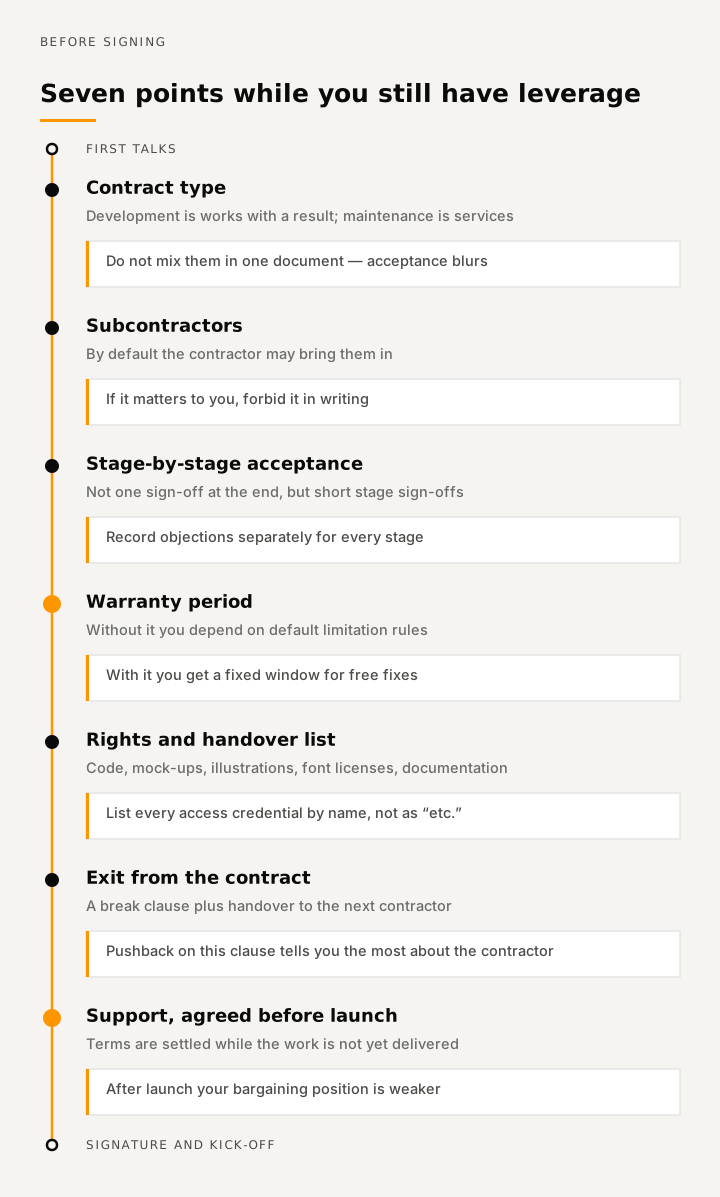
A quick check before you sign.
- Name the contract type correctly. Development is works with a delivered result; maintenance is services. Mixing them in one document blurs acceptance.
- State whether subcontractors are allowed. Under a works contract, the default is often yes. If it matters to you, forbid it in writing.
- Describe acceptance stage by stage. Not one sign-off at the end, but short acceptances per stage with objections on record. The stages of building a website are the natural checkpoints.
- Set a warranty period. Without it you depend on default limitation rules; with it you get a defined window for free fixes.
- Spell out the IP assignment and the handover list. Code, mock-ups, illustrations, font licenses, documentation. Access credentials as a separate item.
- Build in an exit. A break clause and a handover procedure to the next contractor. If the contractor pushes back on exactly this clause, you've just learned the most important thing about them.
- Agree on maintenance before launch, not after. After launch your bargaining position is weaker.
We calculate estimates and timelines with the same logic on our website development page, and for more complex systems on the web applications page. Current packages and price ranges are on the pricing page.
Outsourcing website development pays off when these seven points are closed before the first invoice.
Frequently asked questions
What is outsourcing, in simple terms?
Handing part of your work to an outside provider under a contract instead of keeping someone on staff for it. For development, it means a studio or team builds your website or system, not your employee. Legally it's most often a contract for works: the contractor does the job at its own risk to your specification, and you accept and pay for it.
Is outsourcing development really cheaper than an in-house developer?
Not necessarily. According to Deloitte, only 25% of executives see lower vendor service costs or better quality, and 70% have brought some work back in-house over five years. Outsourcing wins when you need a set of roles for a few months, not one person forever. If changes ship every week and the code holds your unique logic, do the math on hiring.
How is outsourcing different from outstaffing?
With outsourcing you buy a result: a working site, closed tasks, a signed acceptance certificate. With outstaffing, also called staff augmentation, you buy the time of specific people and manage them yourself. The practical consequence: in the first case the contractor is responsible for quality, in the second it's your manager. Many articles that come up for "outsourcing" actually describe staffing, not development.
Who owns the code after the project is finished?
Whoever the contract says, and that's the problem if it says nothing. Default rules differ by country, and in some, including the US, commissioned software stays with the developer without a written assignment. Put an explicit IP assignment in the contract covering code, designs, and documentation. Authors usually keep their personal (moral) rights in any case. Check the wording before you sign, not at handover.
How long do I have to raise quality claims?
It depends on the law that governs the contract, and the default period can be short. A warranty period in the contract gives you a clear window during which the contractor fixes defects for free. Separately, in many jurisdictions a client who accepted work without inspecting it loses the right to point to obvious defects. An acceptance certificate signed without looking costs a lot.
Can the contractor pass my work to someone else?
Under a contract for works, often yes by default: the contractor may bring in subcontractors unless the contract says otherwise, and remains responsible to you for their results. Service contracts often lean the other way, toward personal performance. Don't guess. Write down whether subcontractors are allowed and who exactly will work on your project.
What must stay on my side, not the contractor's?
The domain registered to your company, hosting access, the repository, an owner role in the admin panel, analytics, and Search Console. The UK government's technology procurement standard goes further and advises against letting one vendor be both the component maker and the system integrator. The point is not to depend on them completely.
What should I do if the studio disappears mid-project?
First, record the current state: what has been handed over, what has been accepted in writing, where the code lives, and who owns the access. Then check the remedies in your contract. If defects are material and can't be fixed, or aren't fixed within the deadline you set, a well-written contract gives you the right to terminate and claim damages. Technically, a new team will pick up the project faster the better the repository and documentation look. So ask for them every month, not at the end.
If you're deciding right now whether to give development to a studio or hire someone on staff, write to us. We'll look at your case honestly. If the task calls for an in-house developer, we'll say so. And if it's a job for outsourcing, we'll show you the scope, the stages, and exactly what goes into the contract, before any commercial proposal.
Was this article helpful?
Related articles
 Development
React vs Vue — What Frontends Are Built On in 2026
Guide16 min read
A comparison for whoever pays for the frontend: the hiring pool, stack risk, what maintenance costs, and the honest case where no framework is needed at all.
 Development
B2B website design vs B2C — the difference you can see on the page
Guide13 min read
Where B2B and B2C websites actually part ways: a visible price or a quote request, a cart or a dealer portal, card payment or an invoice with VAT.
 Development
When to Choose Jamstack for Website Development
Guide12 min read
Find out whether Jamstack fits your website: separate content, APIs, and integrations, and see where this approach to choosing a stack runs out.