AI
GlossaryWhat is llms.txt and why does your website need it
Learn what llms.txt is and how to build a clear map of your site for AI agents: the pages that matter, without mixing it up with robots.txt, sitemaps, or access rules.
 Bohdan Kononenko9 min read
llms.txt is a Markdown file in the root of your site that briefly tells language models and AI agents what the site is for and points them to its key content. It is not a file for blocking bots, and it is not an indexing tool. It doesn't tell a system what it can or can't crawl. Its job is different: to give a machine-readable map of the site, so an agent can understand the structure, the main sections, and the priority pages without crawling everything. You don't put Markdown copies of every page into it. You leave a short description and links to the pages that represent the site. llms.txt can make sense for a site with documentation, services, a catalog, or a knowledge base. But it doesn't replace technical SEO, a sitemap, or robots.txt. It's a recommended format, not a way to control search visibility. A model may read the file, use it to get its bearings, or never open it at all.
What is llms.txt?
A short index of your site
llms.txt is a standalone Markdown file with a short index of a site's content for language models and AI agents. It sits in the root of the domain and holds a brief explanation of the site along with links to the pages that best represent the product, documentation, services, or knowledge base.
The format appeared in 2024 as a convention for describing a website in a machine-readable way. An Ahrefs study looks at how widely it has been adopted. Convention is the important word here. It isn't a mandatory web standard, and it isn't a command an agent has to follow. A model may read the file, use it to get its bearings, or never open it at all.
Don't confuse llms.txt with a Markdown version of your site. You don't copy the text of every page, product cards, or the full menu into it. The file should give the gist: what the site does, which sections matter most, and where to go for details.
It isn't a catalog of all your content. It's a short navigation note for an agent. If the site lacks a clear structure and pages with real substance, the file won't fix that. Search visibility takes separate work: SEO optimization.
Why a site needs a file of pointers for language models
An entry point for the agent
A language agent needs the big picture: what the site does, and where to find the product description, documentation, services, or useful resources. Without it, the agent sees a pile of pages but can't always tell which ones are central and which only add context.
llms.txt gives it an entry point. The agent can read a short description and go straight to the pages the site owner picked as the substantial ones. Without the file, agents may need more time crawling the site to understand its high-level structure and main content.
The file doesn't grant access, doesn't hide pages, and doesn't set indexing rules. It only suggests a route: here's what this site is about, and here's where it makes sense to start.
That's why what goes into llms.txt depends on the quality of the site itself. If a service page doesn't explain the offer and the knowledge base repeats itself, a short file won't fix it. First you need to decide which pages carry the meaning and give them a clear structure. That's separate work, covered by GEO, or optimization for AI search.
Having llms.txt doesn't mean every model will read it or use it. The format is advisory: it gives direction, but it doesn't guarantee mentions in AI answers or any change in search visibility.
What llms.txt can contain
The key pages of your site
The content of llms.txt is built around what the site means, not around its menu. It starts with the site's name and a short explanation of what it offers: a product, services, documentation, a catalog, or knowledge on a particular topic. Then come sections that help the agent understand how the site is organized.
Pick links by the role they play. For a product site, that might be the solution overview, product pages, and help docs. For a service business, it's the service pages, how you work, and answers to the main questions. For a knowledge base, it's the topic sections and the articles where a reader would start.
Don't add everything. A contact page, a privacy policy, or a duplicate service card rarely explains why the site is useful. The agent doesn't need every URL, it needs meaningful entry points. Page structure calls for the same approach, and it's part of an SEO audit.
Here's what an example might look like:
# Site name
> A short explanation of what the site is for and its main topic.
## Main sections
- Services
- Products
- Documentation
- Knowledge base
## Optional
The structure has to match the real site. If there's no documentation, don't fake it with a separate section. If the catalog is the main asset, it belongs at the center of the file.
How llms.txt works, step by step
A file in the domain root
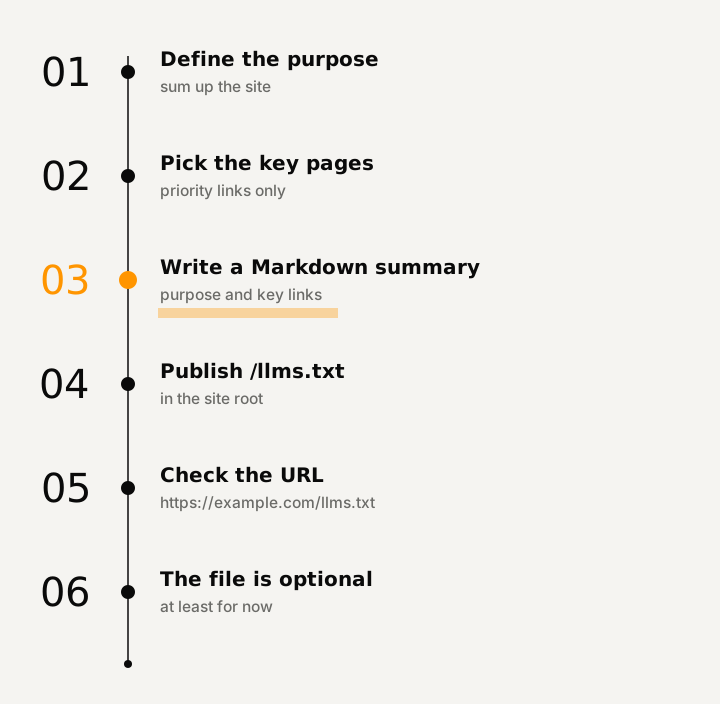
Don't start with the file. Start by answering a simple question: what exactly should the site explain to an agent? For a service business, that may be the services you offer. For a product company, the solution and its documentation. For a knowledge base, the main topic articles. Skip this step, and your list of links turns into a random slice of the menu.
Then the order is:
- State the main purpose of the site in one short sentence. It becomes the basis of the description at the top of the file.
- Pick the pages that actually cover that purpose. These can be service, product, documentation, or catalog pages, or the main sections of a knowledge base.
- Write a short Markdown summary: the site name, a brief description, and links to priority content. Don't add URLs just because they exist.
- Publish the file at
/llms.txtin the domain root. It should open next to robots.txt and the site's other root files, not somewhere inside a random section. - Check the URL after publishing. Make sure the file opens at that path and the content is current.
Creating llms.txt is optional for now. Add it when the site already has clear pages worth pointing to as the main ones. The file doesn't create that structure. It only summarizes it.
How llms.txt differs from robots.txt, a sitemap, and SEO
Each tool has its own job
These tools work side by side, but they answer different questions. llms.txt tells a language model or AI agent what the site is about and which pages to start with. It doesn't control access, doesn't shape search crawling, and doesn't fix page content.
| Tool | Main role | What it contains | What it doesn't do |
|---|---|---|---|
| llms.txt | Gives an agent a short map of the site's content | A description of the site and links to key content | Doesn't control bots and doesn't replace SEO |
| robots.txt | Sets access rules for bots | Directives for paths and sections of the site | Doesn't explain what pages contain or why they matter |
| sitemap | Helps search engines find URLs | A list of the site's pages | Doesn't say which content best represents the site |
| SEO | Makes pages clear to search engines and people | Work on structure, technical health, content, and relevance | Can't be reduced to a single file |
You need robots.txt when the site owner has to set rules for crawlers. llms.txt can't do that: it doesn't control or block anything. If you need to restrict access to a section, that's a job for robots.txt or server access settings, not for a Markdown file full of links.
A sitemap has a different function. It lists URLs so search engines can find them, while llms.txt selects meaningful entry points. A sitemap can hold every important page. llms.txt should hold the ones that give an agent a complete picture of the site.
SEO is broader than both files. It covers site architecture, how clear the pages are, technical errors, duplicate content, and whether the content matches what a person is searching for. We cover that work in What is SEO and website promotion: a plain-English guide for business. llms.txt can describe a strong site, but it won't make a weak structure understandable on its own.
How to prepare your site for visibility in AI search
Page content comes first
llms.txt is useful when there's something for it to describe. The file can point to the main pages, but it won't fix a vague offer, duplicate content, or pages where it's hard to tell what the business actually sells.
Start by identifying the pages that answer a potential client's basic questions: what you do, who it's for, what problem you solve, and what the next step is. That isn't necessarily every item in the menu. A careers page, a privacy policy, or a duplicate service card rarely explains why the site is useful.
Then check that your pages don't contradict each other. A service should have the same name in the navigation, the heading, the body text, and the links. If different pages describe the same offer in different words without explaining how they connect, it's harder for an agent to put together a coherent picture.
Work on content and structure is part of GEO, or optimization for AI search. The point isn't to add one more technical file. First the site has to explain itself clearly to a person. Then llms.txt can show an agent the main content without distortion.
When llms.txt makes sense and when you can skip it
A pointer for a site with substance
llms.txt makes sense when the site already has content you want to present briefly to language models and AI agents. That might be documentation, a knowledge base, a set of services, a catalog, or a site with several substantial sections. In those cases the file helps mark the main entry points: the product page, the core service, the help docs, or the article where a reader should start.
Don't treat it as a mandatory launch step. If the site has few pages, the main content is still taking shape, or the pages don't explain the product, llms.txt will just restate that uncertainty in short form. It also won't help if you expect the file to control bots: other tools exist for that.
First, figure out whether the site's structure makes sense to a person. Does every page have a clear role? Do pages duplicate each other? Does the navigation lead to content that actually explains the business? That kind of check calls for an SEO audit.
Once the content is in place and the key pages are defined, llms.txt becomes a short pointer. Not a replacement for structure, but a reflection of it.
Mistakes when creating llms.txt
Don't list every URL
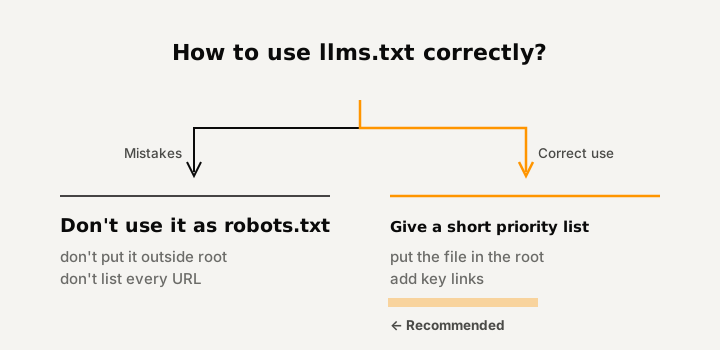
The file belongs at /llms.txt in the domain root. If it sits in a documentation, blog, or downloads folder, an agent won't find it where it expects a pointer for the whole site.
The second mistake is turning llms.txt into a full content export. It isn't meant for Markdown copies of every page. Keep a short description of the site and links to the content that explains the product, services, documentation, or knowledge base.
Don't dump the whole URL list without selecting. Menus, utility pages, duplicates, and minor content dilute the main message. Pick the pages that really represent the site.
Don't try to block bots with llms.txt. The file doesn't control or block anything. Crawl rules go in robots.txt, and access restrictions go in server settings or authentication.
And don't treat llms.txt as a replacement for a sitemap or SEO. Each tool does its own job: one describes priority content, another lists URLs, a third controls access. Clear pages, structure, and content remain part of SEO optimization.
FAQ
Does llms.txt control bot access?
The file doesn't grant access, doesn't hide pages, and doesn't set indexing rules.
Does llms.txt replace a sitemap or SEO?
No. The file doesn't control bot access, doesn't replace a sitemap, and doesn't do the work of SEO.
Where should llms.txt go?
The file belongs at /llms.txt in the domain root.
Conclusion
A short map of your site
llms.txt is a voluntary Markdown file that gives LLMs and AI agents a starting point. It briefly explains what the site is for and leads to the pages that best represent the product, services, documentation, or knowledge base.
Its value depends on what's behind the links. If the key pages clearly say what the business does and who it helps, llms.txt helps present that structure without extra noise.
At the same time, the file doesn't control bot access, doesn't replace a sitemap, and doesn't do the work of SEO. It won't fix duplicates, vague copy, or confusing navigation. That's the job of SEO optimization: work on the site's structure, content, and technical health.
Was this article helpful?
Related articles
 AI
AIHow Semantic Search Changes the Way People Find Things on Your Site
Guide11 min read
Semantic search helps visitors find answers by what they mean, and shows you the content gaps that send people away empty-handed.
 AI
AIWhat a RAG Chatbot Is and How AI Finds Answers in Your Documents
Glossary11 min read
A RAG chatbot answers from your documents, not from guesswork. Here is how retrieval works and what it takes to make the answers reliable.