AI
GlossaryWhat a RAG Chatbot Is and How AI Finds Answers in Your Documents
A RAG chatbot answers from your documents, not from guesswork. Here is how retrieval works and what it takes to make the answers reliable.
 Bohdan Kononenko11 min read
A RAG chatbot is an AI assistant that, before answering, searches a connected knowledge base for relevant passages and uses them as context. You don't have to train the model on every policy, manual, or product description. The documents stay a separate source: you can update, replace, or remove them without touching the model. That is how an internal assistant answers your team's questions about processes, or how a customer-facing helper finds its way around your catalog, policies, and help center.
Uploading files is not enough. If sources duplicate each other, section titles explain nothing, and search pulls a random excerpt, the AI will write a convincing answer that doesn't help. RAG is more than a model and a chat window. It needs prepared documents, search, access rules, and instructions for the assistant: when to answer, when to show the source, and when to say plainly that there's no data. Without those, you just have a chat that sounds confident.
What is RAG?
Search before the answer
RAG stands for Retrieval-Augmented Generation. It is not a separate AI model, and it is not a way to "load your documents into the AI forever." RAG adds relevant context from an external knowledge base to the user's query, and the model writes its answer from the passages it was given.
The chain is simple. A user asks a question, the system looks for related passages in the documents, sends them to the model along with the question, and the model assembles the answer. If the question is about the return policy, the assistant should get the section on returns, not the whole catalog, an email archive, or some unrelated manual.
In RAG, documents don't become model parameters. They stay in a knowledge base, a file store, or a search index. So when a policy changes, you edit the source, and the assistant searches the updated text. A new version of a policy doesn't require changing the model.
That's what separates RAG from fine-tuning. Fine-tuning changes how a model behaves by showing it examples: answer format, style, type of task. RAG pulls in knowledge for a specific question. You can combine the two, but they solve different problems.
RAG doesn't guarantee a correct answer on its own. If search finds an irrelevant or outdated passage, the model works with the wrong context. The structure of your sources, the search index, and the rules for when the assistant answers or declines all matter.
Why connect AI to your company knowledge base
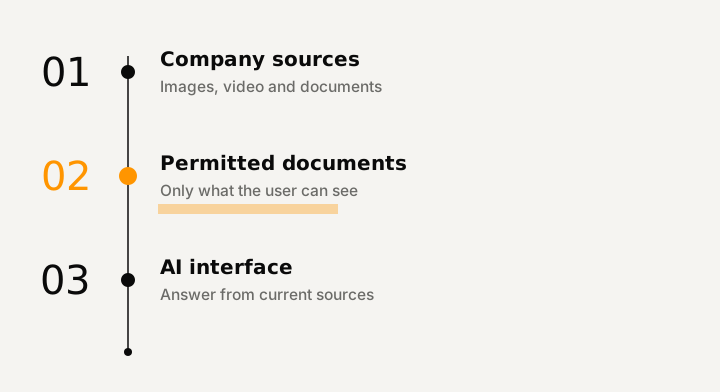
Access to current rules
Companies connect AI to a knowledge base for a reason other than having one more chat in the interface. The point is to give people one way to work with current instructions, policies, service descriptions, internal procedures, and help content. Instead of clicking through folders, files, and pages, the user asks a question and gets an answer from the right source.
For support, it's a way to find rules, terms, and ready-made explanations. Sales can check service details without digging through scattered materials. Onboarding gets an entry point into how the company works. Operations gets a guide through its procedures. Customers get a path to help content, policies, or product information.
The value is access to up-to-date content. A chat that answers with generic phrases or relies on an old file doesn't get the job done. The knowledge base has to stay a managed source: documents get updated, archived, split by topic, and assigned to someone responsible for their content.
User access rights
The assistant's access should never be wider than the user's. An employee sees only materials open to their role. A customer doesn't get internal procedures just because they asked a similar question. This rule applies both to search and to the passages the model receives as context.
When you need more than document search, such as action scenarios, integrations, and role separation, the next step is building AI agents for internal processes and customer support.
How RAG works, from document to answer
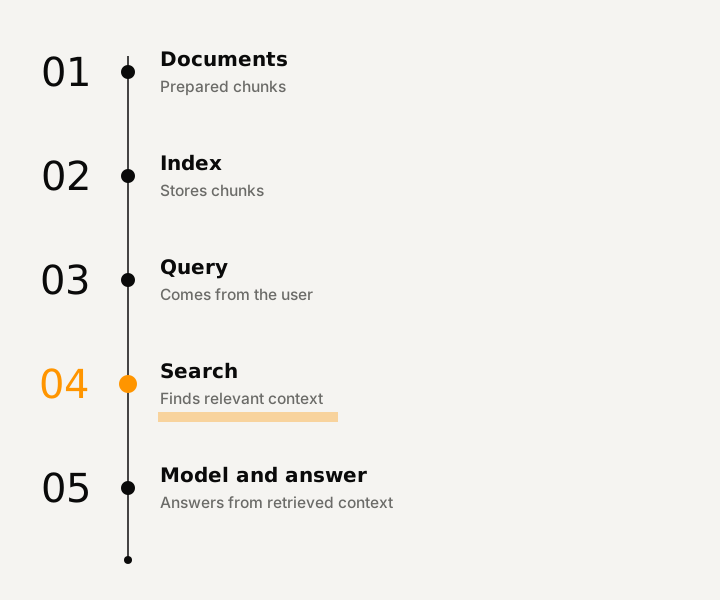
Documents become context
RAG turns documents into searchable context for a specific query instead of handing the model the entire archive. The system prepares the sources, finds the right passages, and only then asks the AI to write an answer. The quality of each step decides whether the user gets a real explanation or off-topic text.
First, the system collects documents from defined sources. From files, knowledge base pages, or company materials it extracts the text and metadata: title, section, status, author, access rights, and other labels used for navigation.
Next, the content is split into logical chunks. The section on returns shouldn't sit in the same search block as shipping terms and a product description. Each chunk has to keep its link to the document, the heading, and the place it came from.
The prepared chunks go into an index. The index lets you search not only for exact word matches but also for similar meaning. Semantic search helps find the answer when the question is worded differently from the text of the policy. Hybrid search combines keyword search with search by meaning.
When a user asks a question, the system checks their access rights and looks for relevant passages in the sources they're allowed to see. The retrieved context goes to the model together with the query. The model writes the answer and, when needed, links to the document.
Don't send the model the whole archive "just in case." Extra context dilutes the query, mixes rules from different topics, and makes the answer harder to control. RAG works better when search brings back a few passages that actually matter.
What determines the quality of RAG answers
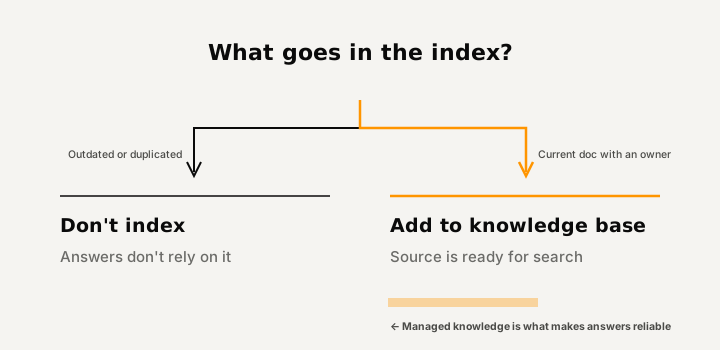
Context shapes the answer
The quality of RAG depends less on the model than on the context it receives before answering. If the knowledge base is a mess, search pulls random passages, and the assistant's rules are vague, the chat can sound convincing and still miss the question.
It starts with how your sources are structured. A document needs a clear title, logical sections, and one unambiguous topic. When a single file mixes rules for different processes, the system may find a passage with similar words but a different meaning. A chunk shouldn't break off in the middle of a condition, an exception, or a reference to a previous clause.
A typical mistake is uploading the current policy next to its old version without marking which one is in force. Search then treats both texts as equals. The assistant may pick the outdated rule or blend incompatible versions.
You avoid this by managing your sources:
- each document gets a status, a last-updated date, an owner, and access rights;
- duplicates get removed, not kept "just in case";
- each chunk is stored with the document title, the section heading, and a link to the original source;
- archived materials are excluded from search or clearly marked as no longer valid.
Rules for the model
A separate layer is the instruction for the model. It should require the model to answer only from the retrieved context, show the source when the answer relies on a document, and say directly that data is missing when search returned nothing usable. Preparation and AI processing of company documents decide whether the assistant becomes a working tool.
How to design a RAG assistant for your team or customers
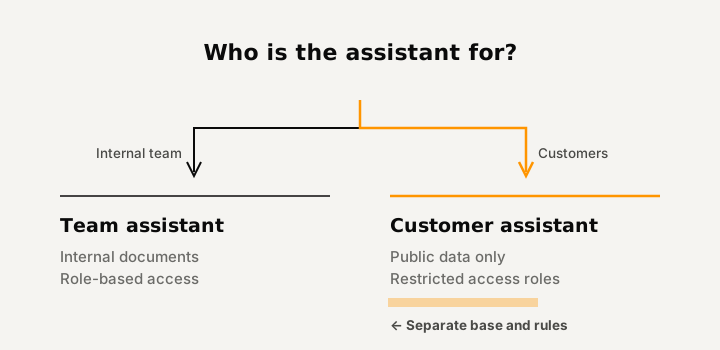
Where the assistant's job ends
Design doesn't start with choosing a model or uploading a folder of files. First you decide who the assistant answers, which questions it's allowed to answer, and where its responsibility ends.
For an internal team, the assistant can work with procedures, instructions, process descriptions, and onboarding materials. Customers need a different base: terms of service, the catalog, public help content, support terms. Don't mix these sources. A customer shouldn't get an internal instruction because they phrased a question a certain way, and an employee shouldn't get only a simplified public answer.
Before development, write down:
- the audiences and roles that can use the assistant;
- the list of sources included in search;
- the documents that must be excluded from the index;
- the limits of its answers and the topics it doesn't handle on its own;
- who is responsible for updating each source;
- the escalation path to a person when there's no context or the question needs a decision.
Declining without guessing
The assistant needs a rule for declining. If search found nothing to base an answer on, it shouldn't fill the gap with a guess. It says the available materials don't contain the information and routes the request to a defined channel.
What is fine-tuning an AI model?
Tuning how the model behaves
Fine-tuning adjusts the behavior of an existing AI model with examples, for a particular answer format, communication style, or class of tasks. It doesn't give the model a knowledge base in the usual sense. Instead of searching documents, the model learns patterns from prepared examples: how to phrase an answer, what structure to keep, how to classify requests or turn input data into the right output.
RAG pulls context from external sources at the moment of the query. If a policy changes, you update the document and the index. Fine-tuning changes how the model behaves, but it gives you no simple way to show which document an answer came from.
So fine-tuning shouldn't replace a knowledge base when your rules, catalog, or internal instructions change regularly. What matters there is a current source, access rights, and the ability to open the original document. That's RAG territory.
Combining RAG and fine-tuning
The two approaches can work together. A fine-tuned model can answer in the format you need while RAG feeds it current context. The choice depends on the task: do you need the model to behave consistently, or do you need answers tied to specific documents? For a wider comparison, see the differences between AI agents and chatbots.
RAG chatbot, document search, or a chatbot without a knowledge base — which to choose
The task decides
The choice depends on whether the person needs an answer, a list of sources, or consistent model behavior. Regular search finds documents, and the user draws the conclusion. A chatbot with no connected sources writes text from the model's general knowledge but doesn't know your company's internal rules. A RAG chatbot combines search with conversation, while fine-tuning changes how the model performs a given type of task.
| Approach | What the user gets | Where the knowledge lives | How information is updated | When it fits |
|---|---|---|---|---|
| RAG | An answer based on retrieved passages from documents | In the connected knowledge base and search index | By updating the source and the index | You need a conversation around rules, help content, or a catalog that changes |
| Regular document search | A list of documents or passages to read yourself | In a file store, knowledge base, or index | By updating documents and the index | People prefer to read original sources and draw their own conclusions |
| Chatbot without connected sources | A general explanation, a draft, or wording | In the parameters of the base model | Not updated through company documents | You need general text, ideas, or writing help |
| Fine-tuned model | An answer in a set format, style, or fixed logic | In the examples used to tune the model's behavior | Through a new fine-tuning cycle | You need consistent classification, answer structure, or request handling |
RAG is the right fit when a user asks in their own words and the system returns an answer from relevant context. It helps when documents change and the answer has to rely on the current source.
Regular search is still the right call when an employee needs to see the full document, compare wording, or judge exceptions for themselves. Not every query needs to become a conversation with AI.
A chat without a knowledge base is fine for general wording. But it shouldn't answer on behalf of company rules it never received. Fine-tuning doesn't replace a knowledge base either: it sets behavior, it doesn't pull the current policy into a specific question.
If the line between a chatbot, RAG, and a system that takes actions is still fuzzy, it helps to look at the differences between AI agents and chatbots.
Where RAG helps and where it doesn't replace other tools
Answers from current documents
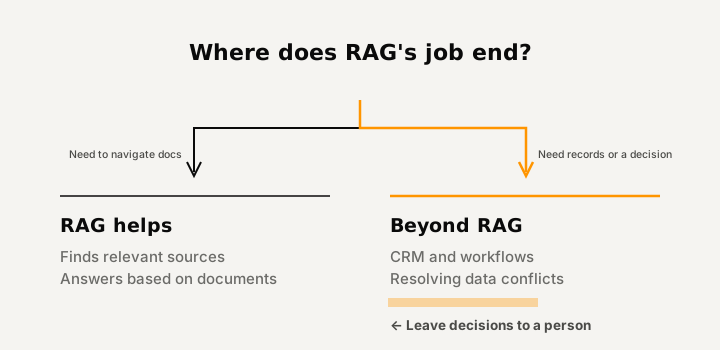
RAG helps where a person should get an answer from current documents instead of hunting for the right section by hand. It can explain internal rules and processes, help support find answers in the knowledge base, surface product details, or guide a user through company documentation. It doesn't replace the sources themselves: it gives you an interface to them. RAG finds the answer in what's already written. Forecasting demand or churn from your own numbers is a job for AI analytics.
For a team, that could be a question about the approval process, terms for a service, or how to handle a request. For a customer, a question about the catalog, help content, or available terms. Either way, the answer has to come from documents that user is allowed to see. A restricted procedure shouldn't end up in the customer assistant's context just because it sits in the same storage as the public help center.
RAG doesn't replace a CRM
RAG doesn't replace a CRM when you need to create a deal, edit a contact, assign an owner, or log an action in the sales process. That takes a system that works with structured customer data and permissions for operations. More on that in what a CRM system is and why a business needs one.
RAG also won't fix contradictory documents. If the base holds different versions of a rule, the assistant may find any of them. The source owner has to decide which version is current, remove duplicates, and mark access restrictions.
The assistant shouldn't make decisions a person is accountable for. Its job is to find context, explain the rule, and pass the request on when the documents give no basis for an answer. For organizing sources and extracting content from files, look at AI processing of company documents.
Key takeaways
Context instead of training on the archive
RAG gives an AI model context from your documents at the moment of the query. It doesn't train the model on the entire company archive or turn procedures into its internal memory. The system finds relevant passages, sends them along with the question, and only then writes the answer.
Reliability doesn't come from the chat itself. You need clear sources, a marked current version, access rights, search by meaning, and rules for the assistant. It should answer only from the context it received. If there's nothing to base an answer on, the right move is to say the data is missing or hand the request to a person.
A RAG chatbot doesn't replace order in your knowledge base. It makes that order available as a conversation.
FAQ
RAG and company documents
What is RAG?
RAG is an approach where the AI, before answering, finds relevant passages in connected documents and passes them to the model as context. It isn't training the model on your company archive: the documents stay a separate knowledge base you can update without changing the model.
How is RAG different from fine-tuning?
RAG pulls knowledge from external sources for a specific question, while fine-tuning changes the model's behavior through examples: answer format, style, or type of task. If a policy changes, with RAG you only need to update the document and the index.
What should happen if a RAG chatbot doesn't find an answer?
The assistant shouldn't fill the gap with a guess. It says the available materials don't contain the information and routes the request to a defined channel.
Was this article helpful?
Related articles
 AI
AIHow Semantic Search Changes the Way People Find Things on Your Site
Guide11 min read
Semantic search helps visitors find answers by what they mean, and shows you the content gaps that send people away empty-handed.
 AI
AIWhat is llms.txt and why does your website need it
Glossary9 min read
Learn what llms.txt is and how to build a clear map of your site for AI agents: the pages that matter, without mixing it up with robots.txt, sitemaps, or access rules.