E-commerce
GuideHow to build an ecommerce website without the extras you don't need
How to approach ecommerce website development so the catalog, payments, shipping and order handling run as one process instead of four disconnected ones.
 Bohdan Kononenko12 min read
Ecommerce website development means building a system where a shopper finds a product, places an order and pays for it, while the business sees that order and fulfills it. Design is not the starting point. First you define the product range, the customers, the pricing and stock rules, and the shipping and payment options. Then you decide who fills the catalog, who processes orders and who fixes errors in the data.
Skip that, and you can end up with beautiful mockups that never pass an order into your actual workflow. Or with a site where changing a product page takes a developer again. That makes your business dependent on someone else's calendar.
Mobile can't be left for the end. A shopper shouldn't have to hunt for the cart, guess whether an item is in stock or re-enter details the store already has.
The order of work: describe how you sell, choose how to build, design the path to the order, connect the operational processes and test the whole flow before launch.
What is an ecommerce website?
One set of data for selling
An ecommerce website is a system where the catalog, product page, cart, checkout, payment, shipping, order processing and admin all work from the same data. Without that link, a storefront only displays products. Staff end up checking the price, stock level, product variant or shipping method by hand.
A product page has to make sense both to the shopper and to the person fulfilling the order. The shopper sees the name, specs, available variants, price, availability and delivery terms. The person fulfilling the order gets the same data without decoding comments from a messenger chat.
If the catalog has variants, each one needs to be tied to its own stock level and pricing rules. Otherwise the site will show an item as available when the size, color or configuration the shopper wants is already gone.
Before design, lock in the operational decisions:
- where product data comes from and who updates it;
- how the site determines availability and what it shows when an item is out of stock;
- where the store sells and which shipping options are available;
- who receives a new order, changes its status and talks to the customer;
- how cancellations, returns and order errors are handled.
These answers shape the catalog structure, the copy on product pages, the cart logic and the messages sent after checkout. "Make it like our competitors" doesn't help much here. Stores that look alike can track stock, collect customer data and hand orders over to fulfillment in very different ways.
Products with sizes, colors or other variants need their own catalog logic. For an example of that scenario, see an online clothing store with product variants.
Where to start: products, customers, payment and shipping
Start with the product
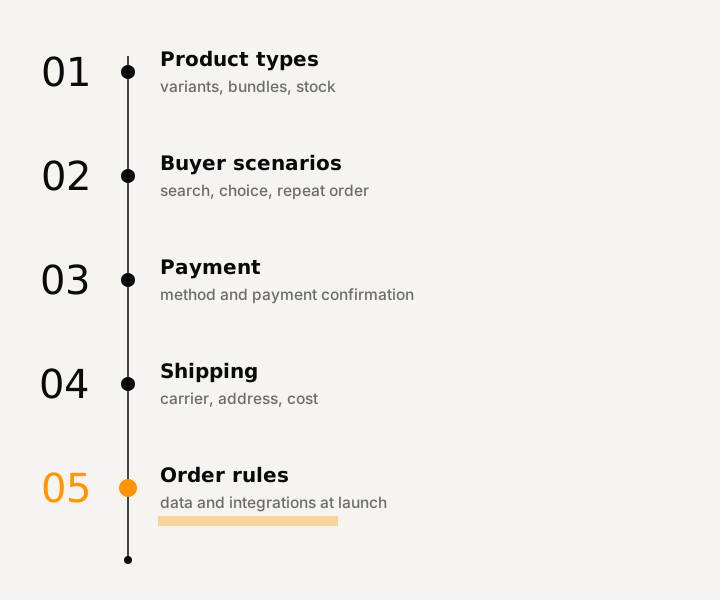
Don't start with a list of pages. Start with the product and how you sell it. Describe your product types, their variants and the data a shopper needs to pick the right one. Then define the scenarios: what people search for, which attributes they compare, when they need a hint and what information they're willing to give at checkout.
Clothing, furniture, cosmetics and auto parts don't fit one catalog template. For clothing, the size, color and availability of that exact variant matter. For furniture, it's dimensions, material, configuration and how the buyer receives it. Cosmetics need clear properties and size options. An auto part has to be tied to compatibility parameters, or the shopper can't choose it with confidence.
After the products, pin down the order path:
- Which payment methods are available and when the shopper picks one.
- Which shipping options you offer and what data each one requires.
- How the site shows availability, reserves an item or reports that it's out of stock.
- Who changes the order status and what happens after a cancellation or return.
This determines the data structure, the product page logic, the checkout fields and the integrations that pass the order on to fulfillment.
One availability rule
The availability rule has to work the same way in the catalog, the product page, the cart and the order data. Otherwise a shopper will order something that's already gone, and a staff member will find out only after the order is confirmed.
The full sequence from idea to launch is covered in How to build an online store from scratch: 9 steps from idea to launch.
What to build an online store on: a platform, a CMS or custom development
The choice has to support the process
You don't choose how to build a store by the product name. You choose by whether your sales rules fit into it. A hosted platform works when the catalog, pricing, checkout and order processing can run on its built-in logic. A CMS gives more control over the catalog and content, but within the limits of the available extensions. Custom development is needed when the template starts telling the business how to sell.
A marketplace is a separate channel, not a replacement for your own store. It gives you a place to list products, but not full control over catalog structure, the shopper's path or the rules for handling orders. If the business wants to decide those things itself, its own website stays the main point of sale.
| Option | When to consider it | What the business controls | Where the limits show up |
|---|---|---|---|
| Hosted platform | Your processes fit the platform's rules | Products, content and the available settings | Non-standard catalog, pricing and order rules |
| CMS | You need to manage the catalog and content through extensions | Page structure, product data and content | Capabilities depend on the extensions and their logic |
| Custom development | Your rules don't fit a template | Data, roles, workflows and integrations | Processes must be clearly described before work starts |
| Marketplace | You need an additional sales channel | Listing content within the marketplace's limits | Less control over the catalog and the shopper's path |
The test is simple: describe a non-standard situation without generic words. For example, a product has several variants with separate stock, prices or shipping rules. Then decide where that rule will live, who will change it and what the shopper will see on the product page and in the cart.
If the answer comes down to a manual workaround or a third-party add-on with no clear owner, the solution doesn't fit the process. A long feature list doesn't equal flexibility. What matters is whether you can support the logic you need without constant developer involvement or duplicated data.
The selection criteria are collected in What to build an online store on in 2026: 6 platforms and when each one fits.
How to design the catalog, product page and checkout
A catalog built around how people search
You design a catalog around how people look for products, not around a tile layout. Categories and filters come first. They should match the attributes shoppers use to narrow their choice.
If an attribute isn't stored in the product data, it won't become a reliable filter. If a filter leads to products that lack the attribute, it just creates extra clicks.
Once the catalog structure is set, define the required attributes for each product type. Some are needed for search, some for choosing a variant, others explain the delivery terms. One catch-all field for every spec works poorly in filters and in the admin alike.
The shopper's decision on the product page
The product page gathers the shopper's decision in one place. It should show the product, its price, availability, available variants and shipping terms. Choosing a variant should update the related data. The shopper shouldn't have to guess whether the price and availability apply to the size or color they picked.
┌─────────────────────────────┐ │ [ PRODUCT ] │ │ Basic T-shirt │ │ Price │ │ Color: black │ │ Size: M │ │ ● In stock │ │ Shipping: per store terms │ │ │ │ [ Add to cart ] │ └─────────────────────────────┘
A cart is more than a list of items. The shopper should see the selected variant, the quantity, the current terms and the way to checkout. Don't make them go back to the catalog to remember what exactly they added.
Checkout collects only the data needed for payment, shipping and contact about fulfillment. A field without a clear purpose doesn't belong there. Shipping rules should shape the form: not every delivery method needs the same information.
Filters, variant selection, the cart and the order form should be clear without hovering or hunting for hidden actions. On a small screen, a structural mistake shows up immediately.
What to set up for payments, shipping and product management
Payment and shipping are one process
Payments, shipping and product management should be one process, not a set of separate buttons. The shopper sees the available terms before checkout and understands what happens after it. An admin changes product data without hand-editing several pages. The person fulfilling the order gets the data the shopper entered.
The setup splits into three loops:
- the shopper sees payment and shipping options, what's in the order, its status and notices about changes;
- the admin manages products, prices, stock, variants and order status;
- the operational process passes data between payment, shipping and fulfillment.
Describe every integration in terms of data and events. Not "connect shipping," but what gets sent after checkout, what changes after confirmation, where an error shows up and who fixes it.
A stock change should affect whether the shopper can buy the item. A canceled order should be visible to whoever handles fulfillment. Data shouldn't sit in one service while a staff member digs for it by hand in another.
New technology and automation make the customer journey and order fulfillment more efficient. But automation doesn't fix vague rules. If nobody has defined who updates stock or when an order moves to a new status, the system will just pass the confusion along faster.
Describe the exceptions in advance
Document the exceptions separately. What happens if the item is already gone? What does the shopper see when a payment doesn't go through? Who responds when shipping data fails to transfer? These are the moments when a store either keeps a clear process or forces staff to track orders down by hand.
If your rules for products, statuses and data handoffs don't fit a standard setup, you need online store development built around your processes.
How to prepare requirements before handing the store to developers
Describe how data moves
Online store requirements describe how product data, orders and responsibility move between the shopper, the website and the people who fulfill orders. "Make it like our competitors" doesn't explain what should happen when a price changes, a product goes out of stock or a shopper cancels a payment.
Start with roles. Write down who adds products, changes prices and stock, sees a new order, confirms it and answers customer questions. One person can hold several roles. What matters are the boundaries of access and responsibility.
Then describe the product data. For each product type you need a list of attributes, variants, and rules for pricing, availability and catalog display. Note separately where the data enters the store and who fixes an error when a name, price or stock level doesn't match reality.
Order statuses need a route too. Listing them isn't enough. Define the event that moves an order into a new state, who sees that change and what data gets passed on. Describe the exceptions the same way: an unpaid order, an unavailable item, a shipping error, a partial cancellation or a return.
For integrations, state the action, not just the name of the service: what the site sends, when that happens, what response it expects and where a failure notice appears. That removes the situation where part of the data stays in one loop and a staff member searches for it by hand in another.
A description like this turns a general wish into a workable spec.
How to get an ecommerce website ready for launch
Test the whole order path
Launch doesn't start with publishing the site. It starts with testing the full order path. A single button can work perfectly. That doesn't mean a shopper will find the product and place an order, get a notification, and that a staff member will see the right data in the admin.
Fill the catalog and check the data. Name, description, price, availability, images, variants and category should match what the business is actually ready to sell. If a product has variants, check each one. A shopper shouldn't be able to add an unavailable variant to the cart or see a different price after selecting one.
Walk through the flow as a shopper:
- find a product through the catalog or search;
- apply filters and make sure they don't hide the products you need;
- choose a variant and add it to the cart;
- change the quantity, go back to the catalog and check that the cart kept its contents;
- place the order and choose payment and shipping;
- check the notifications the shopper gets after a status change.
After checkout, open the admin. The order should appear with the customer's details, the cart contents, the payment method, the shipping method and the current status. Then change the status and check whether the shopper sees it and whether the person fulfilling the order gets the information they need.
Assign owners
Name an owner for the catalog and for order statuses. Someone has to update prices, availability, descriptions and images. Someone has to respond to new orders, cancellations and data errors. Without that, the site quickly turns into a storefront full of outdated information.
Prepare the pages people will land on from search and ad campaigns. They should lead to a specific product, category or collection instead of making the visitor start searching all over again. The general website launch sequence is described in Building a website from scratch in 2026: 8 steps that actually work.
After launch, collect feedback from shoppers and staff. Repeated questions, order errors or confusing statuses show where the flow needs to change.
Conclusion
A store starts with how you sell
Ecommerce website development starts with the sales model, not with picking a template or a button color. First define what you sell, how price and availability are set, who works with the catalog and what happens to an order after checkout.
That's where the requirements for the catalog, product page, cart and checkout come from. They should reflect how people actually choose products and never make the shopper search for information the store already has.
A hosted platform, a CMS or custom development should support the business's rules, not force the business to adjust to arbitrary limitations. Integrations are part of the flow as well: you need to know what data is passed, when the status changes and who sees an error.
A store should remove extra steps, not add new ones.
Frequently asked questions
Answers to the key questions
How do you build an ecommerce website?
Start with the sales model: product range, customers, pricing and availability rules, shipping and payment. Then choose how to build the store and design the catalog, product pages, cart and checkout. After that, decide who handles orders and data in the admin.
What do you need to prepare for an ecommerce website?
Prepare product data, pricing and availability rules, variants, order scenarios, payment and shipping. Also name the people who will update the catalog and respond to new orders, cancellations and data errors.
Which is better for an online store, a hosted platform or a CMS?
Consider a hosted platform when your business processes fit its rules. A CMS works when you need more flexible control over the catalog and content within the limits of the available extensions. The criteria for choosing an approach are described in What to build an online store on in 2026: 6 platforms and when each one fits.
When does an online store need custom development?
Custom development is needed when your rules for the catalog, pricing, roles, integrations or order processing don't fit the system you've chosen. Describe not only a regular sale but also cancellations, returns, unavailable items and data transfer errors.
What pages does an ecommerce website need?
The sales scenario determines the set of pages. You usually need a catalog, categories, product pages, a cart, checkout, payment and shipping terms, plus service pages for handling orders. Every page should lead the shopper to a clear next step.
How do you test an ecommerce website before launch?
Walk through the full shopper path: find a product, apply a filter, choose a variant, add it to the cart and place the order. Then check payment, shipping, notifications and whether the order appears in the admin. The whole flow matters, not individual buttons.
An extended practical guide: steps, common pitfalls, checklists and FAQ you can actually work through.
Was this article helpful?